• Registration is now open. It usually takes me a couple of hours or less to validate accouts. If you are coming over from VoD or DR and use the same user name I'll give you Adult access automatically. Anybody else I will contact by DM about Adult access. NOTE I do have spam account creation testing on, but some spam accounts do get through and I check all manually before giving them access. If you create an account where the user name is a series of random letters, the email address is another series of random letters and numbers and is gmail, and the IP you are creating the account from is a VPN address noted for spam, it is going to be rejected without apology.

Marbles

TailsWin

Well-known member
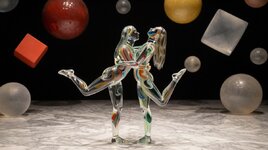
Well, this looks like another silly 3D render test that makes me nostalgic about... silly 3D render tests.

What I find interesting is that even this pretty basic model (by today's standards) does reflections pretty well. Like, not that long ago, something like this would take half an hour to render because of raytracing. Sooo... Why do we even need to calculate raytracing, which is still computationally pretty expensive, when AI can approximate it pretty well? All those AI videogame enhancements make sense. From a philosophical perspective, it's funny how machine learning can crack so many random problems which otherwise require a crapton of effort.

Also, I think this has some NSFW potential, I just haven't got that far yet.
338.jpg
343.jpg
 
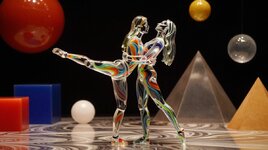
Well yes and no, those reflective surfaces aren't reflecting what's in the scene, ray tracing of course would. So while it is aesthetically pleasing it isn't photo-real, and in this case since there aren't any organic objects a ray traced render would be.

Of course with video games zipping by at 40 frames a second nobody is going to notice, much as they don't notice how film clips tend to be really blurry because the shutter speed is too low to catch motion.

Now that you have me thinking about it though I need to go back through some AI rendered video clips frame by frame to see what is going on.
 
Well yes and no, those reflective surfaces aren't reflecting what's in the scene, ray tracing of course would. So while it is aesthetically pleasing it isn't photo-real, and in this case since there aren't any organic objects a ray traced render would be.
Well it is an approximation, or In this case more like an impressionist idea of a reflection. But it's still cool. In the first image, top left, the reflection of a round off-white table and the two cubes on the red ball, I think that's quite neat. And I didn't prompt that in, in fact I was prompting for diffuse opaque shapes. The model added it anyway, since the reflection made sense to it.

It's like adding such details when painting. You're not calculating it super accurately, just eyeballing it.

But the thing is, better models are much better at this, and video models even better, up to the point that it can be basically 1:1 replacement for actual raytracing for normal purposes. It's not like real raytracing is actually 100% real world anyway - it's still just our best guess of how the physics works, translated into algorithms, diffused through lossy floating point math, and projected using a specific grid. Every surface you want to reflect/refract/whatever, you have to specify by describing its surface parameters. Just more math and algo parameters underneath. So you could train a neural network to do the same thing, just like you can train it to add two numbers. It's just a different kind of algorithm to get to the result.
 
Back
Top